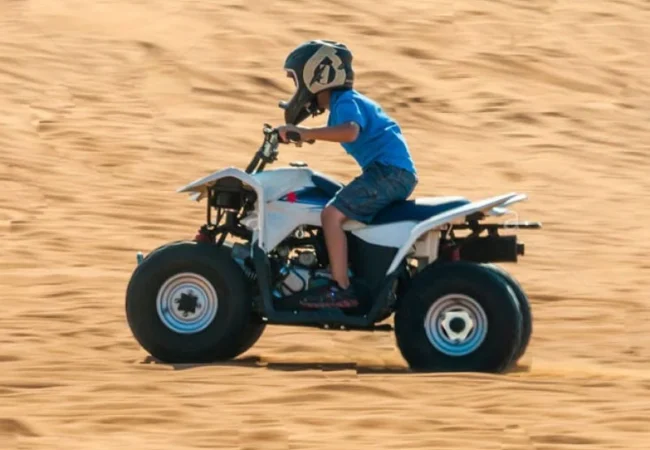
 AED 150
Yamaha 90cc
- Ages 9-12
- Track
- Supervised
Built for a child, not shrunk down from an adult machine. It stays on its own marked lane beside the main site, so parents can watch every lap while gearing up for their own route.
Book this ATV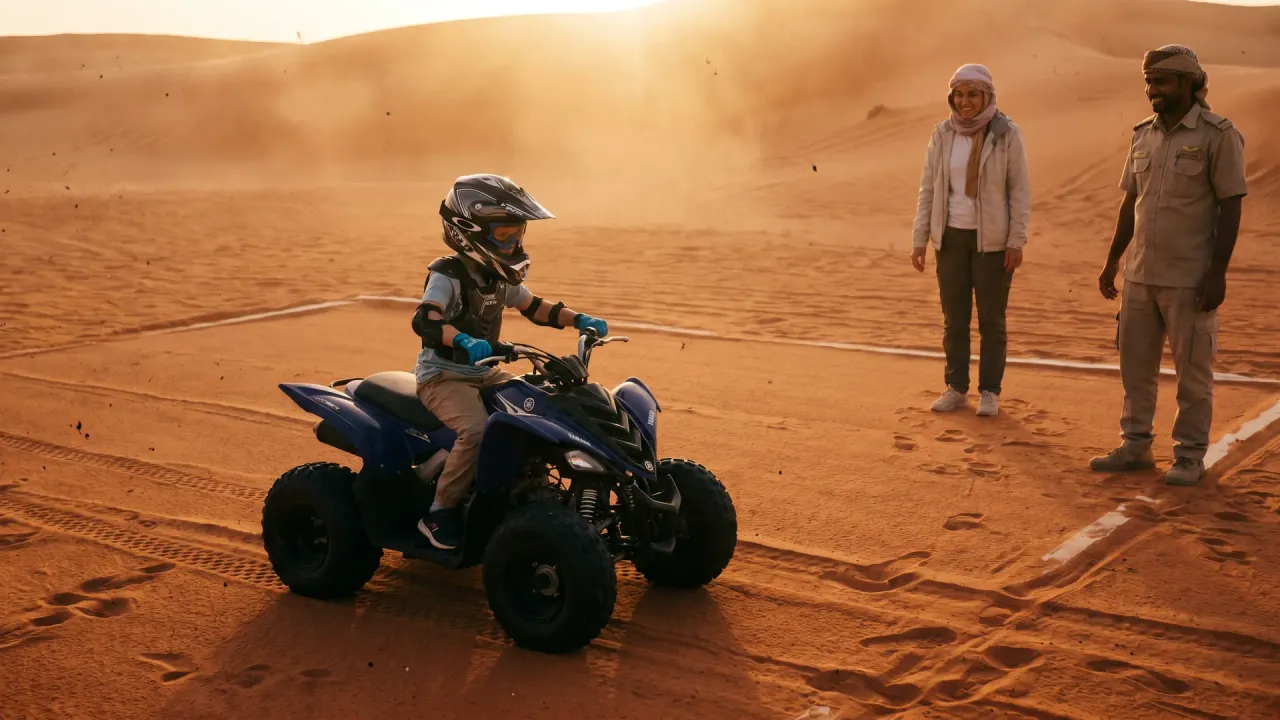
Bring the whole family and nobody sits in the car park. A child from nine to twelve gets a supervised 90cc on its own marked lane; a parent or older teen rides a full guided route on a Yamaha matched to their level. Same site, same morning, two different rides that end at the same water stop.
Most desert operators solve "the kids" by sitting them on a passenger seat next to an adult. This one gives a nine-to-twelve-year-old an actual machine to steer — a supervised 90cc on its own lane, guardian standing right there, for AED 150 — while a parent or older teen rides a proper guided route on a Yamaha sized to their own experience, from AED 200. Everybody drives something; nobody just watches.
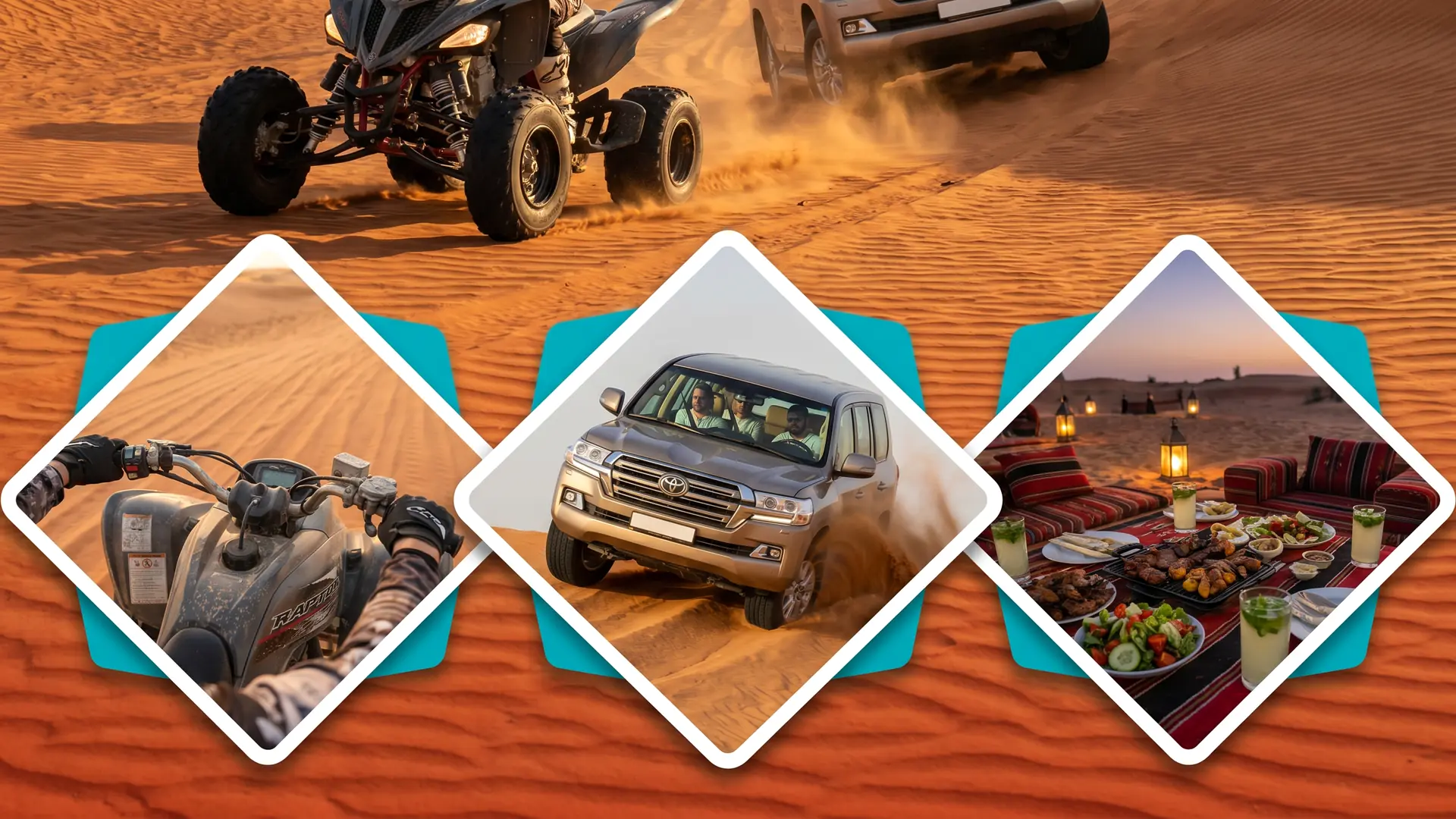
For a first family trip, book the Evening Safari with ATV and BBQ at AED 375. The dune bashing runs in a Land Cruiser so small arms aren't doing any work, the ATV leg gives each kid their own machine time on the supervised lane, and the evening ends at a camp with dinner rather than a hungry drive home. Secure online advance payment confirms your booking, support available 24/7.
Pricing is set per person on every machine, and a child's 90cc gets its own line rather than a discount folded into an adult's booking. The 400cc double is the one exception — a single seat built for two, for a parent riding tandem with a child not quite ready to solo. Nothing is charged until ages, headcount and pickup are confirmed.
| Machine | Suits | From |
|---|---|---|
| Yamaha 90cc | The kids' machine — ages 9 to 12 on a supervised lane, guardian required on site. | AED 150 |
| Yamaha 220cc | The parent, teen or grandparent who has never ridden. Light and forgiving. | AED 200 |
| Yamaha 400cc | What most parents end up on. Handles the family route without drama. | AED 250 |
| Yamaha 400cc double | One seat, two riders — a parent up front with a younger child riding along. | AED 350 |
| Yamaha 400cc turbo | Same frame, more pull. Booked by parents back for a second family trip. | AED 350 |
| Yamaha Grizzly 450cc | Heavier and steadier — worth asking for if the adult route runs long. | AED 450 |
| Sports quad 625cc | For the parent with real riding hours who wants a faster loop of their own. | AED 700 |
| Yamaha Raptor 700cc | Fastest on the fleet, released after a check — kept well away from the family lane. | AED 795 |
From a child's first throttle to a parent who rides every other weekend, there's a machine built for where each person actually is. The guide reads the warm-up and puts everyone on the right one — nobody gets waved onto something too big.
AED 150Built for a child, not shrunk down from an adult machine. It stays on its own marked lane beside the main site, so parents can watch every lap while gearing up for their own route.
Book this ATV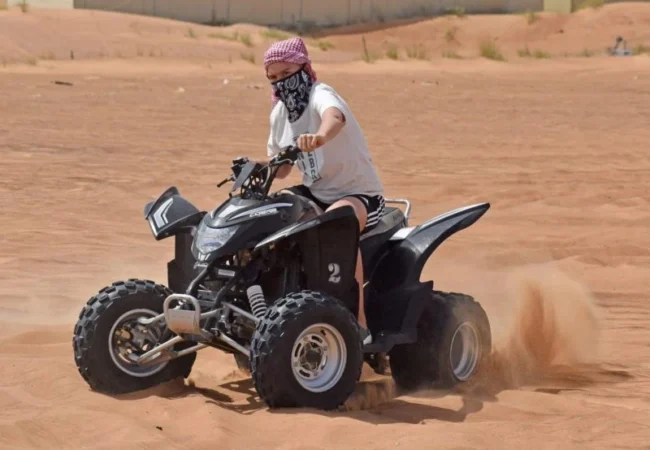 AED 200
The machine handed to the parent who has never ridden anything with a throttle. Light steering, gentle power, and forgiving enough that a first attempt looks better than expected.
Book this ATV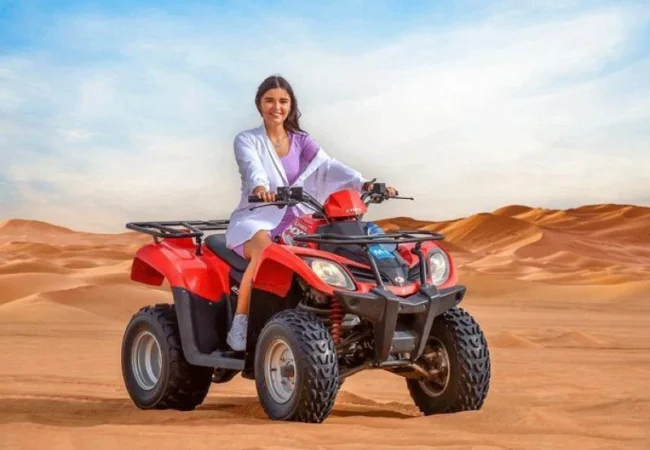 AED 250
What most mums and dads end up on once the kids are settled on the 90cc. Enough machine to actually enjoy the route, without punishing a rider who's a little rusty.
Book this ATV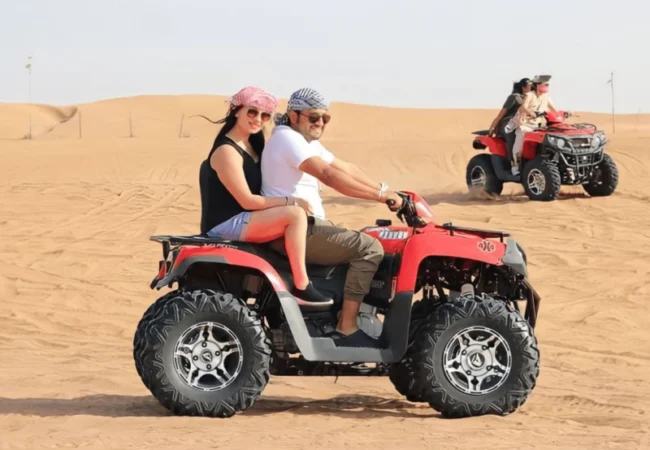 AED 350
One seat, two riders — built for a parent taking a child along who's keen but not quite at solo-90cc age. Both still get real machine time out on the sand.
Book this ATV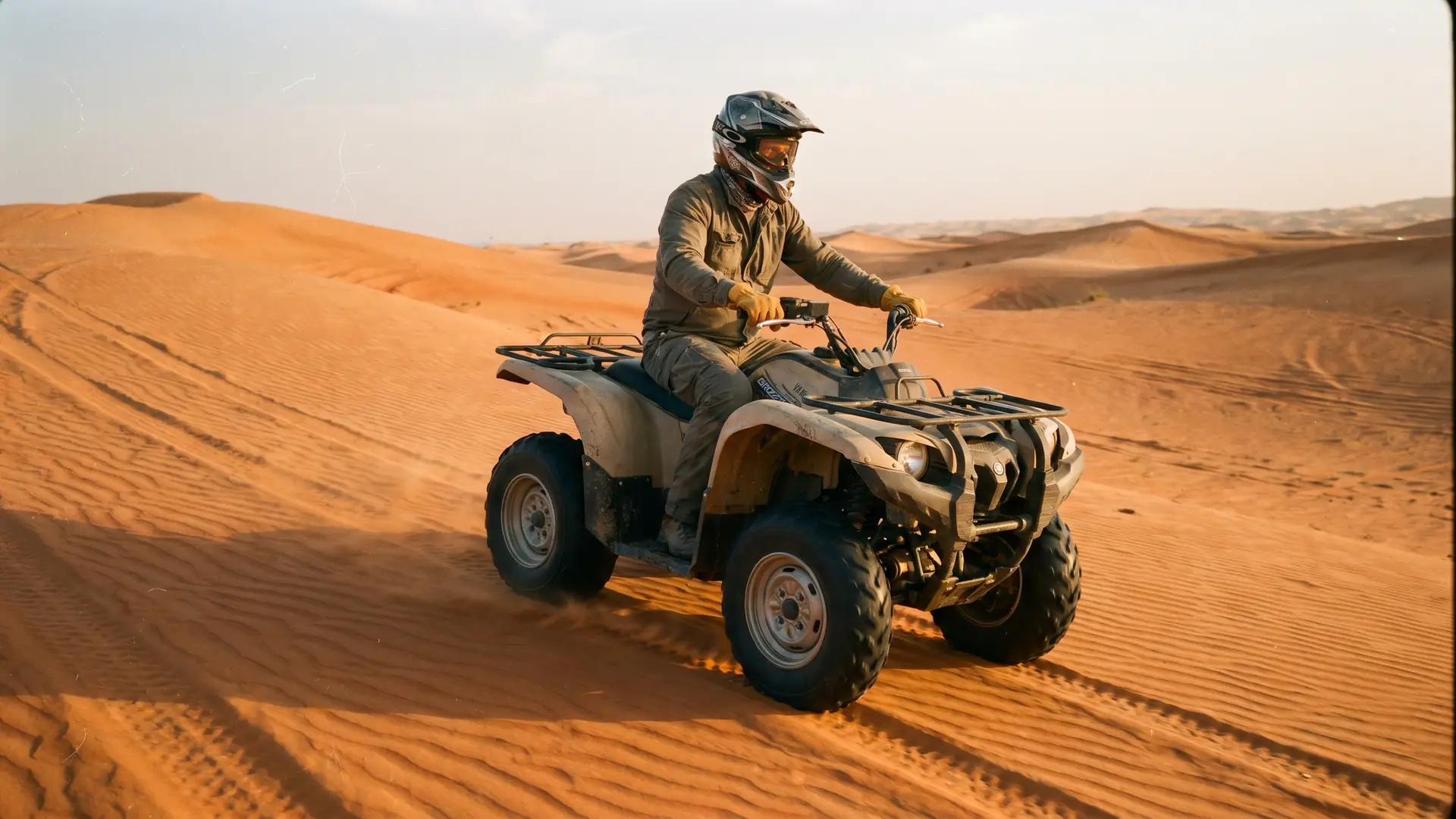 AED 350
Same familiar frame as the standard 400, with more pull out of the bowls. The one parents ask for by name once the family tour becomes a repeat outing.
Book this ATV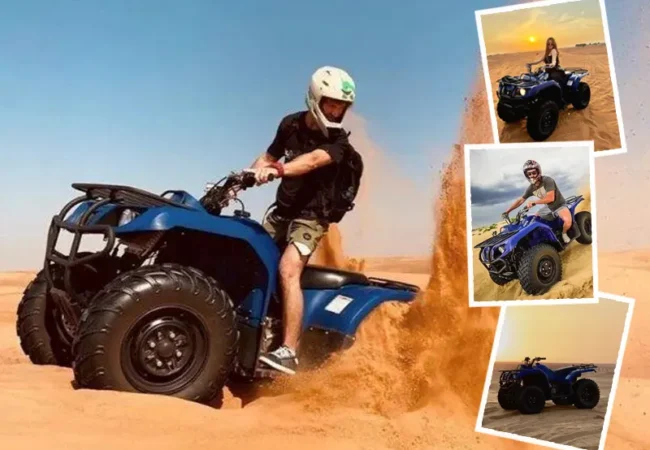 AED 450
Heavier and steadier over broken ground, which suits a parent stretching their loop while the kids' session runs on the lane. Ask for it if you've booked extra time.
Book this ATV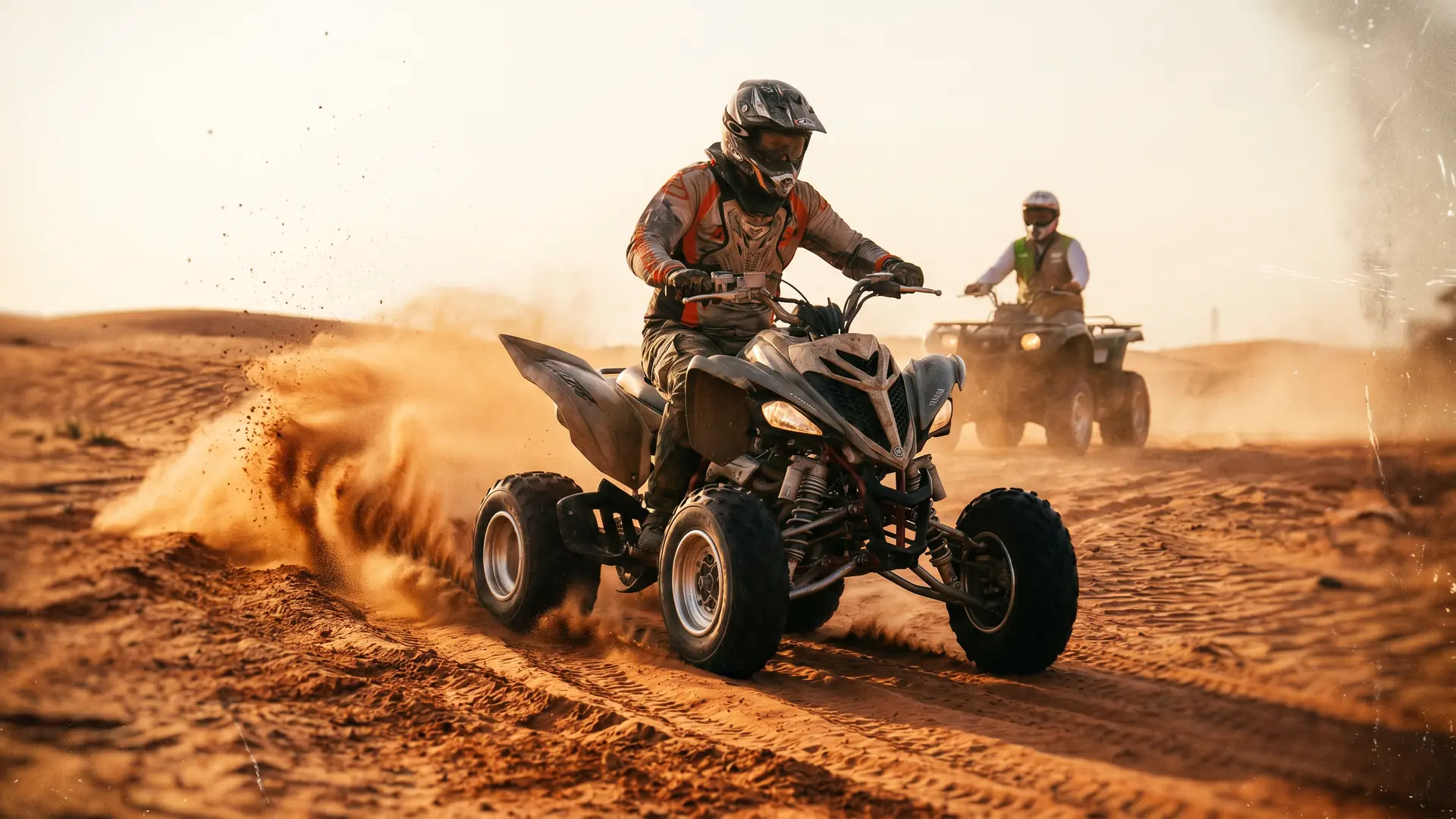 AED 700
Not a family machine — this is the one a parent books solo after dropping the kids at the 90cc lane, for twenty minutes that belong entirely to them.
Book this ATV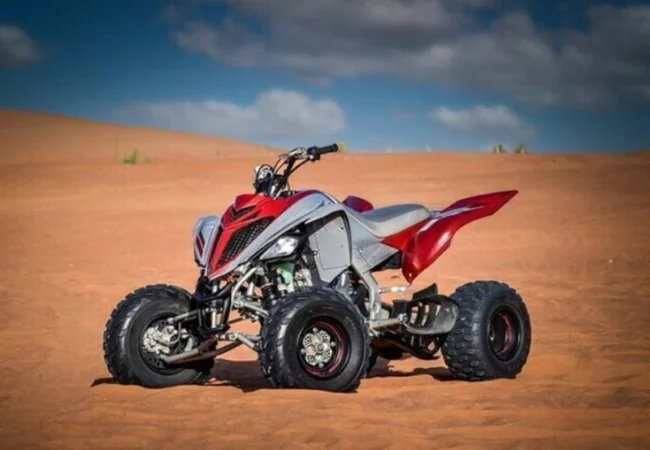 AED 795
Handed over after a short conversation about what you've actually ridden before, and kept well clear of the family lane — the reward for clearing the check while the kids loop the track.
Book this ATVAn hour is what the ATV leg takes; getting there and back eats forty-five minutes each direction. With kids along for the ride, folding in the safari and a proper dinner is what justifies that drive — and it's why these four combinations outsell booking the ATV on its own.
 AED 375
Small arms get a break during the Land Cruiser dune bashing, then the 90cc lane and the guided adult route go one after another, followed by sunset over the ridges and halal BBQ at camp. Usually the first thing a family books.
Book this tour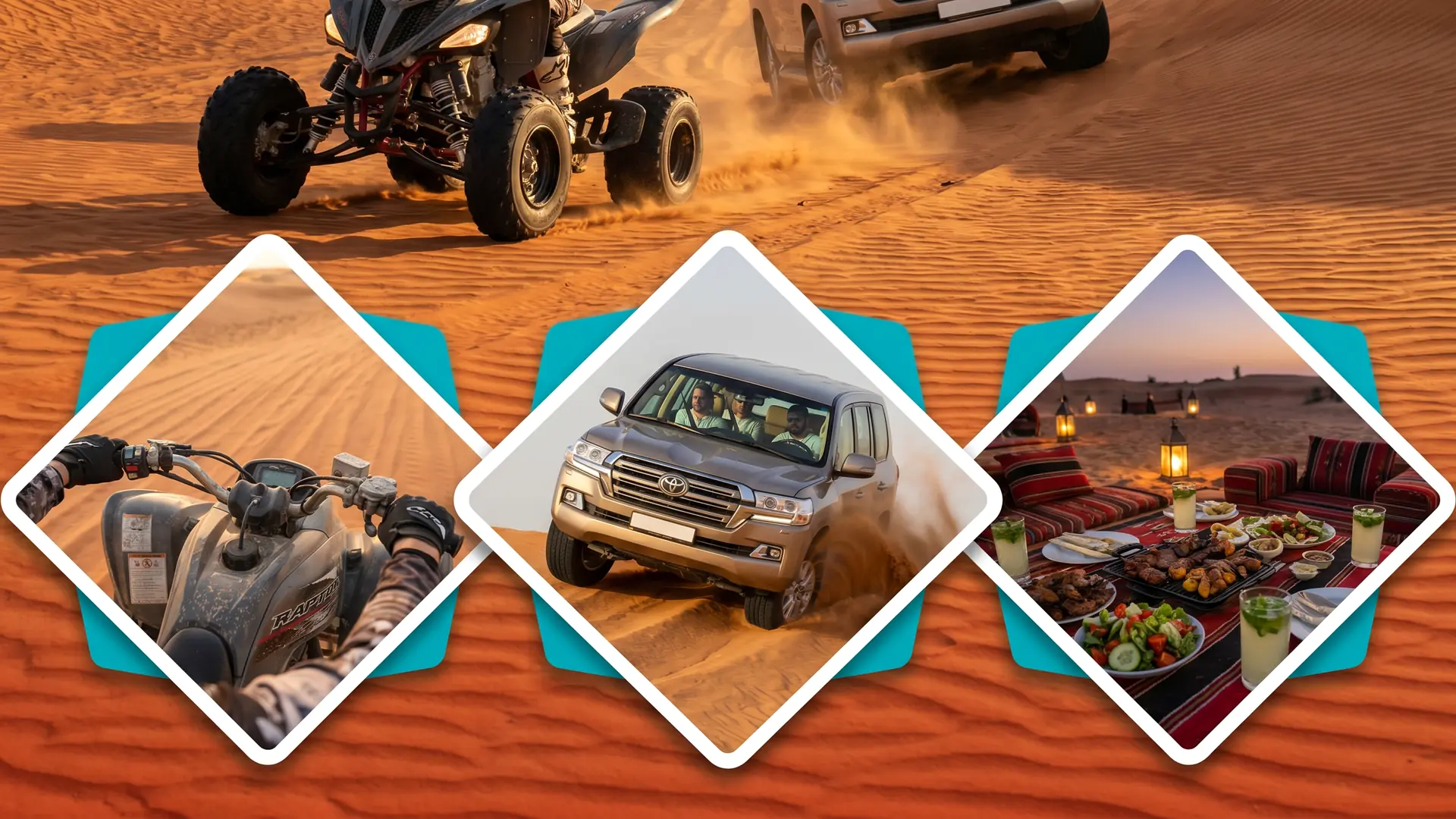 AED 290
The sand hasn't loosened up yet from the overnight cool, so a child's first laps on the 90cc come easier, and the adult route feels steadier underfoot too. There's still a full afternoon left for the pool once the group is back in the city.
Book this tour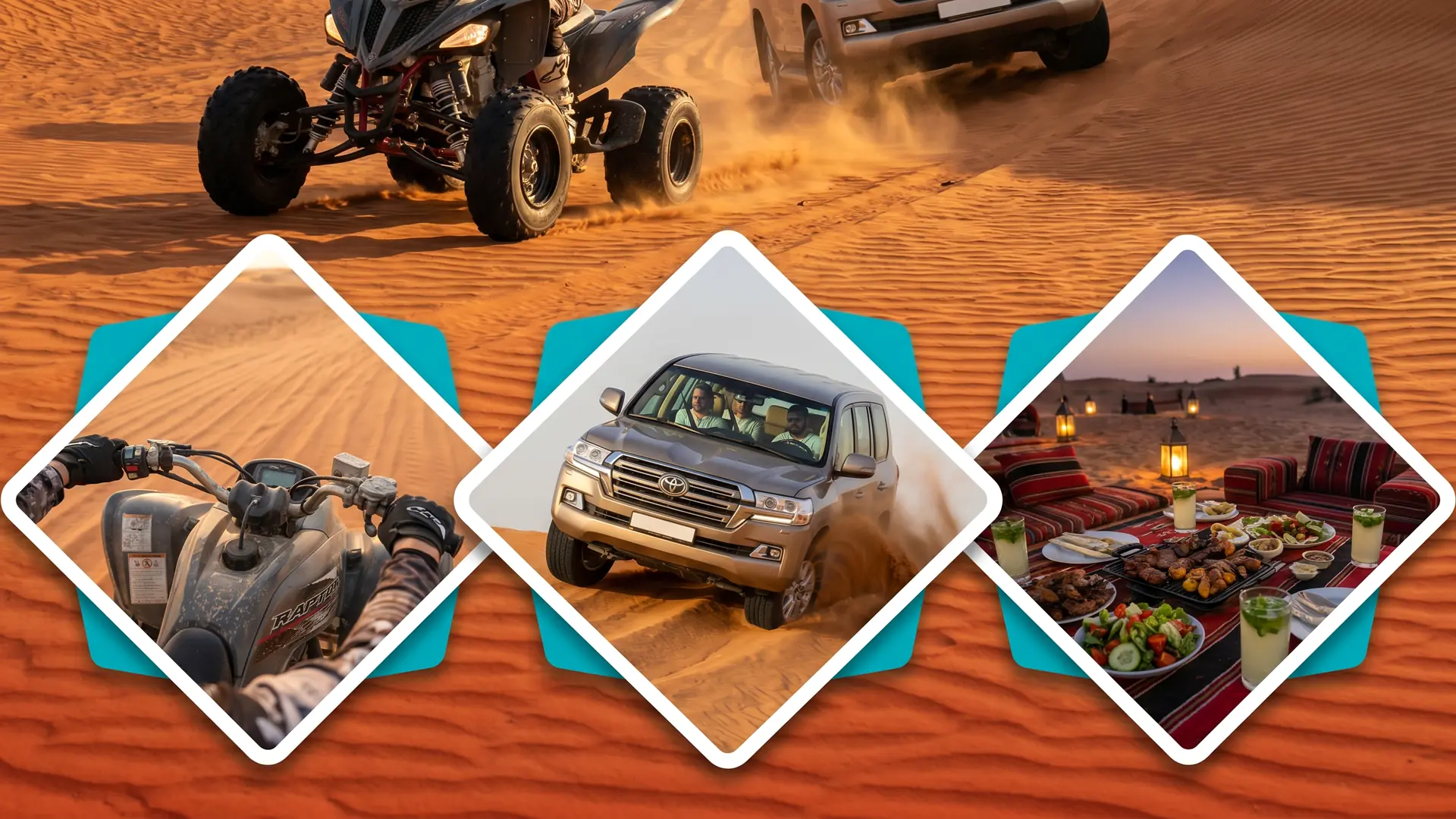 AED 700–1,300
For families who'd rather skip the dune-bashing leg altogether. Straight to the ATVs — kids on the 90cc, parents on their route — then the camp and dinner. Price moves with the machines booked.
Book this tour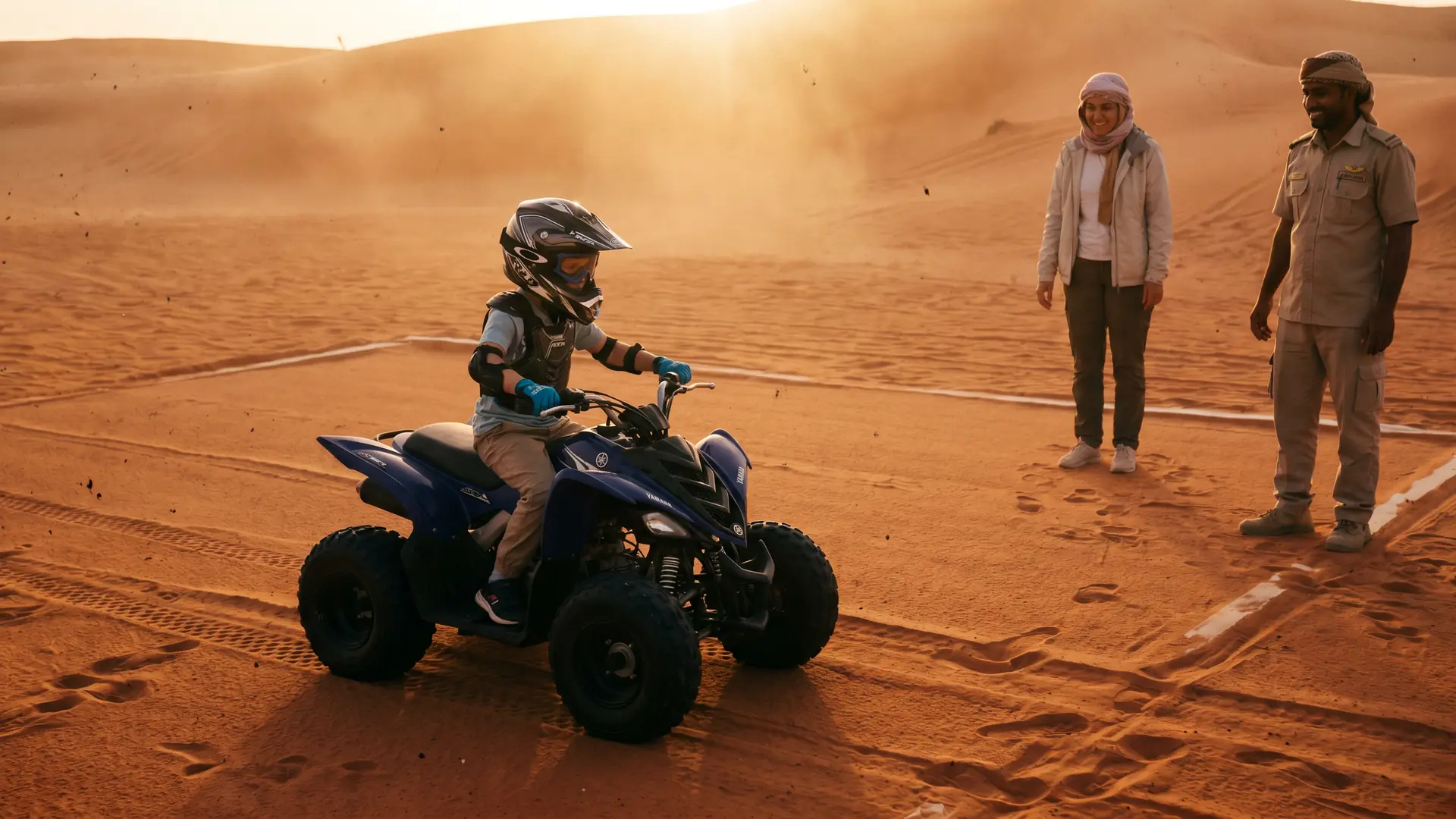 AED 150
The kids loop the supervised 90cc lane while the adults are out on a full guided route — same base, same window, so nobody spends the morning waiting in a car park.
Book a family tourThis is about the grown-up machine, not the kids' — the 90cc lane is set by age, not by anyone's riding history.
The drive shapes a family booking more than most people plan for.
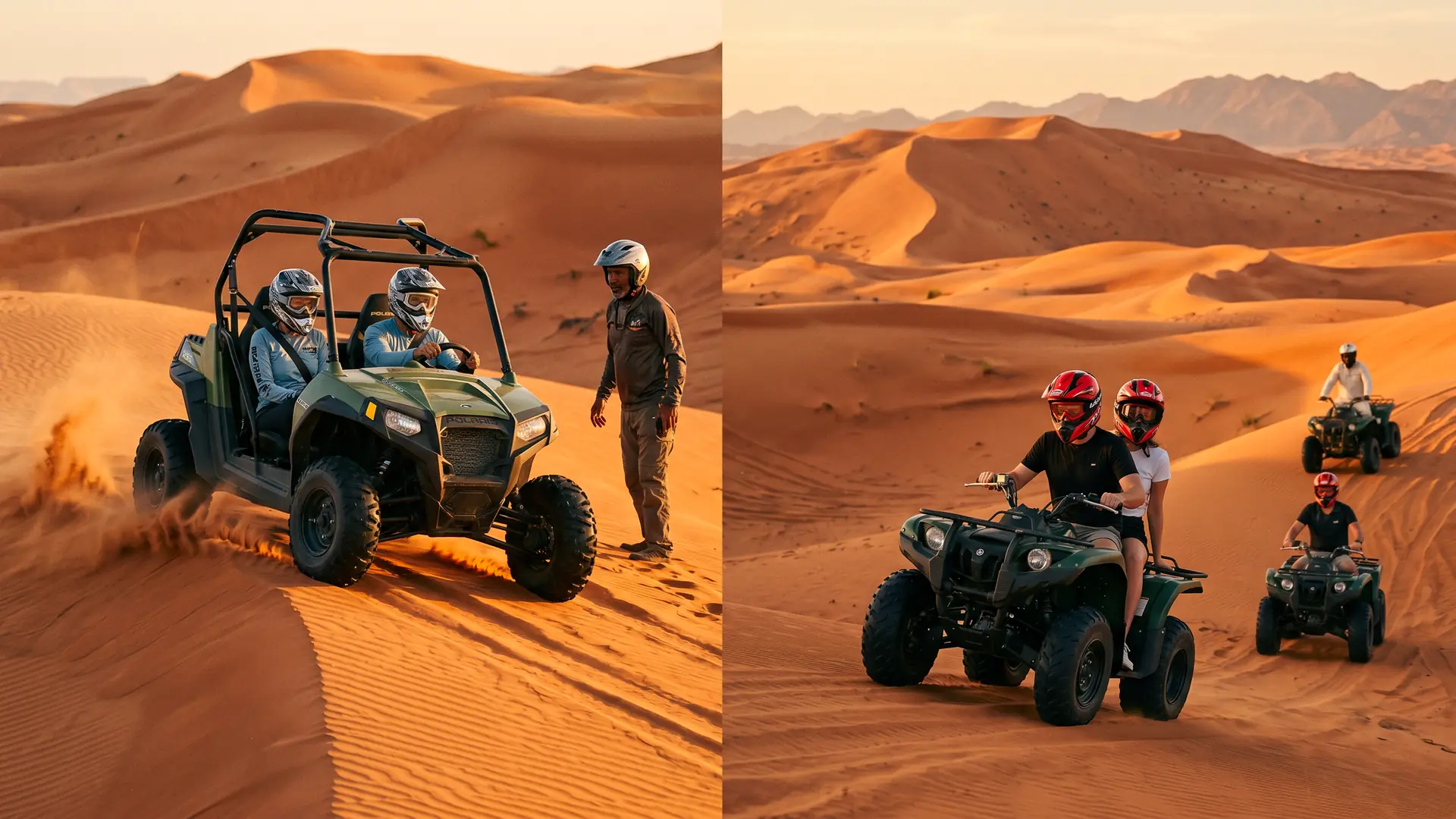
A buggy solves a different problem than the ATV does — a harnessed passenger seat for a child too young even for the 90cc, or a steering wheel for the parent who'd rather not grip a handlebar. Plenty of families book both in the same trip.
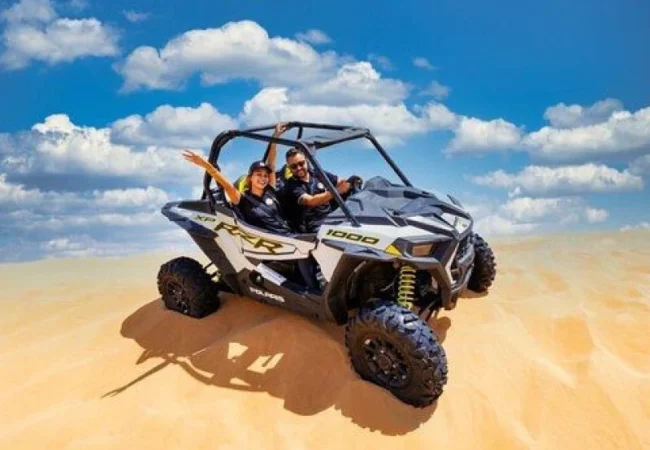
Roll cage and harness rather than a throttle grip — the seat some parents prefer, with room for one passenger riding along beside them.
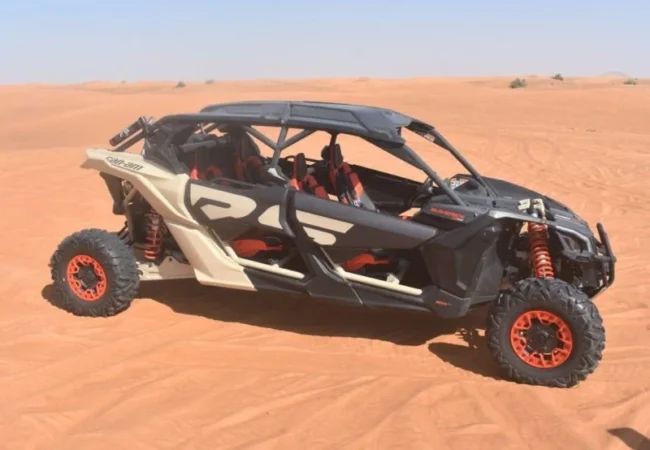
Wide enough for most of the family in one vehicle. One fee covers the buggy, not each seat, which suits a group with more passengers than riders.
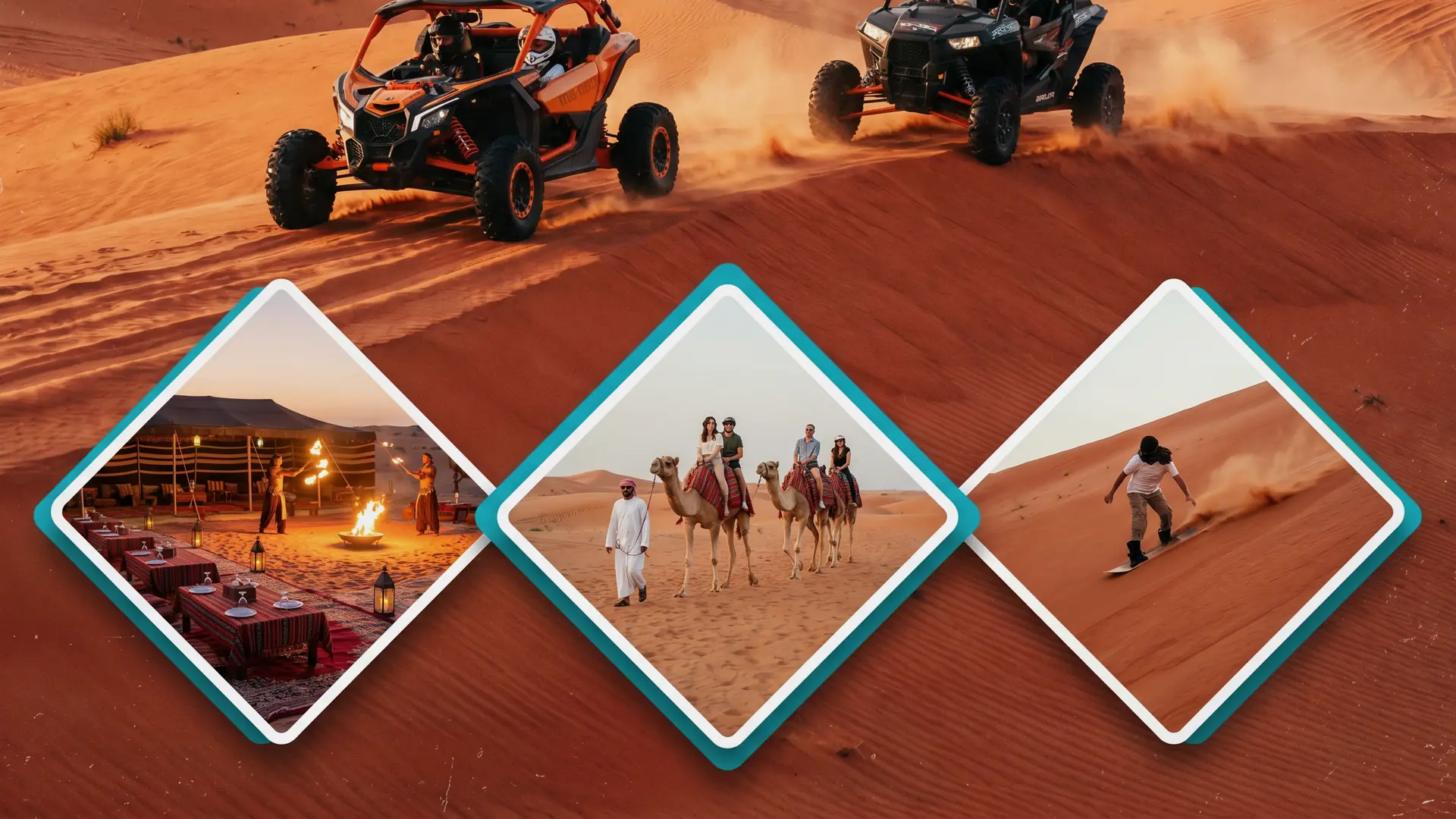
First the kids get their laps in on the 90cc while parents run the ATV route, then the whole group climbs into the buggy together for the last leg. Once the machines are chosen, the total settles somewhere between AED 290 on the low end and AED 1,100 on the high end.
There's no age exception and no supervised version of this. It's the solo adrenaline stop for a parent with real off-road hours, taken while the kids loop safely on the 90cc lane.
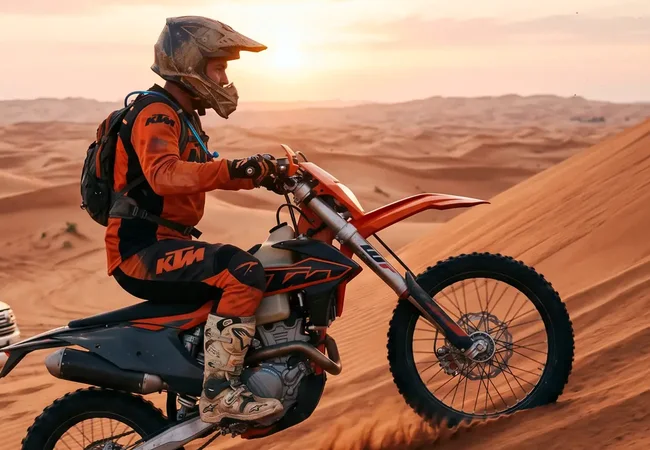
AED 850 buys the first hour, AED 1,250 the second. This isn't a machine that gets taught from zero — bring genuine off-road time or the sand will find you out fast.
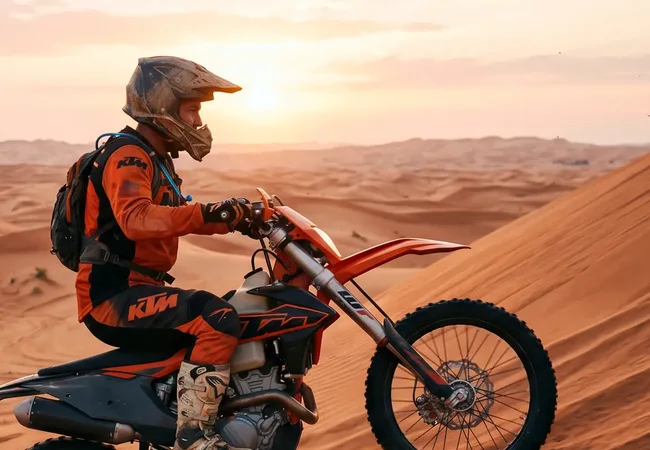
Reserved for the advanced route, handed over only after a rider check, minimum one hour. Pricing is confirmed once we've seen you ride — not a family booking, and not meant to be.
Missed the cut on the KTM? Four wheels on the Raptor 700cc deliver most of that same speed with far less that can go wrong — and it stays just as far from the family lane.
A trained driver handles every dune from behind the wheel of a Land Cruiser, starting at AED 225. It's where grandparents, younger siblings still below riding age, or anyone who'd simply rather watch the ATVs than ride one usually end up.
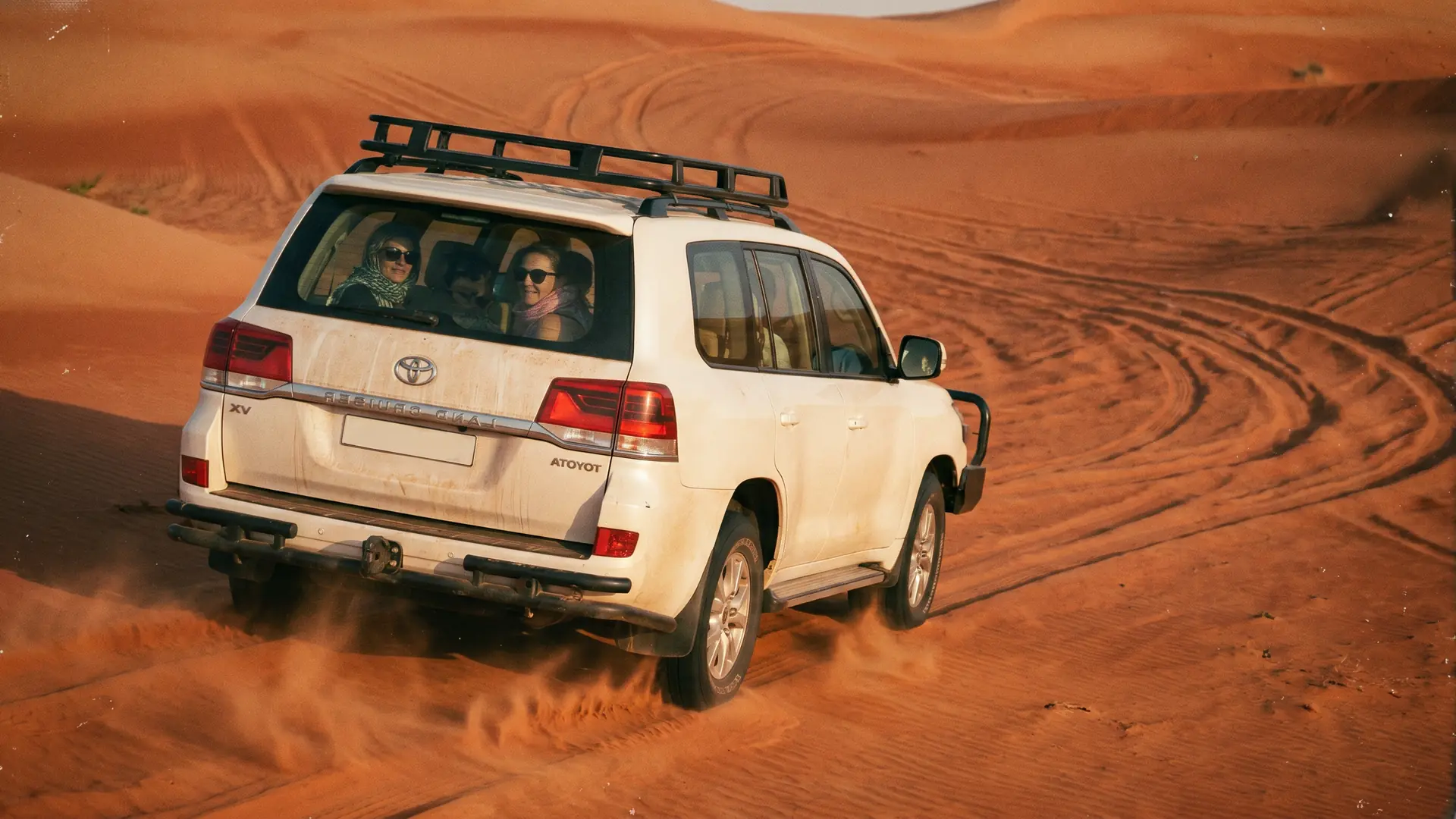
Cooler sand and quieter dunes come with the early departure, and the group is back in the city long before anyone needs a nap.
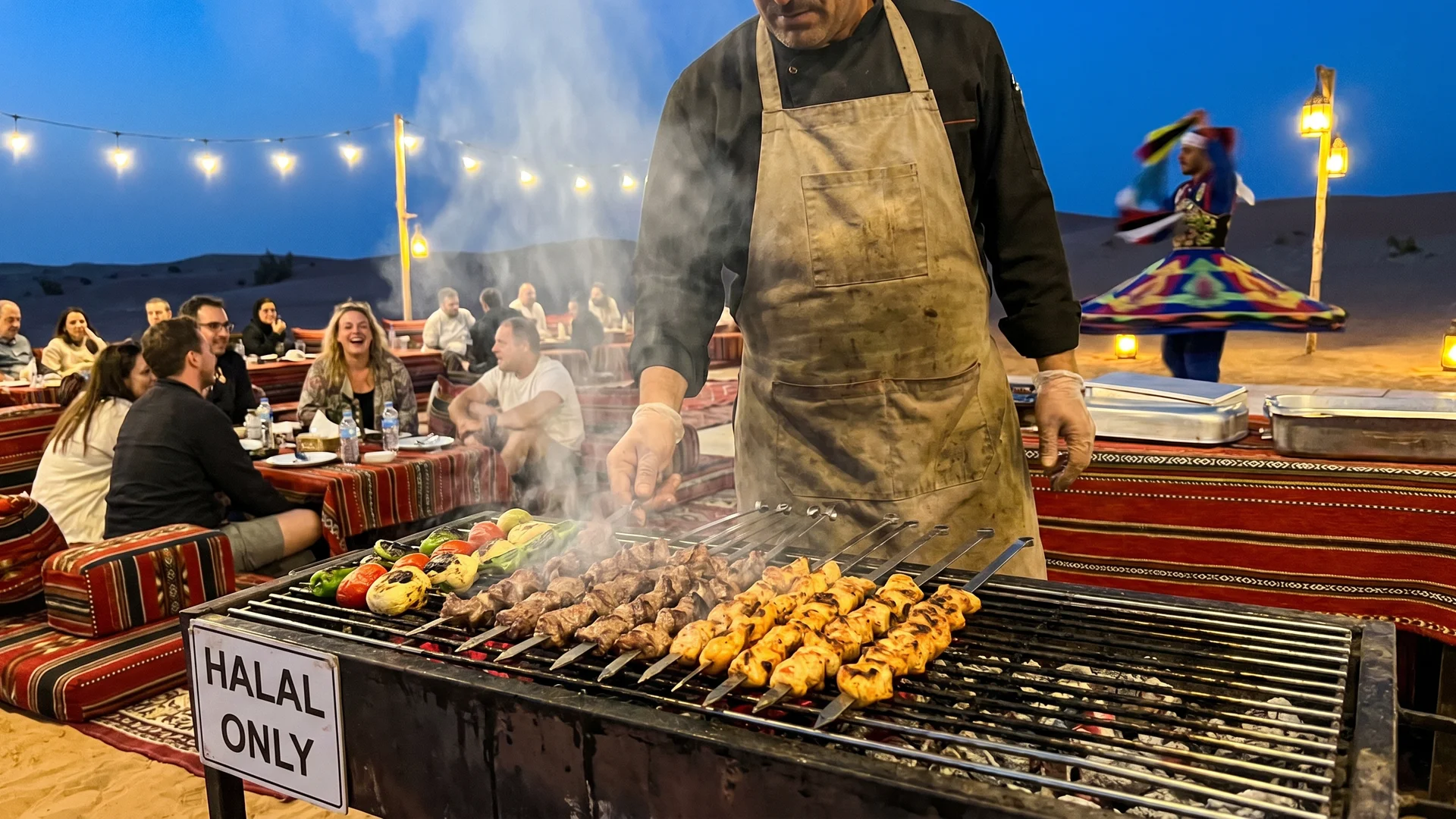
A loop through the dunes as the light turns gold, then halal BBQ at camp with both directions of transfer covered — the simplest choice for whoever's sitting the ATVs out.
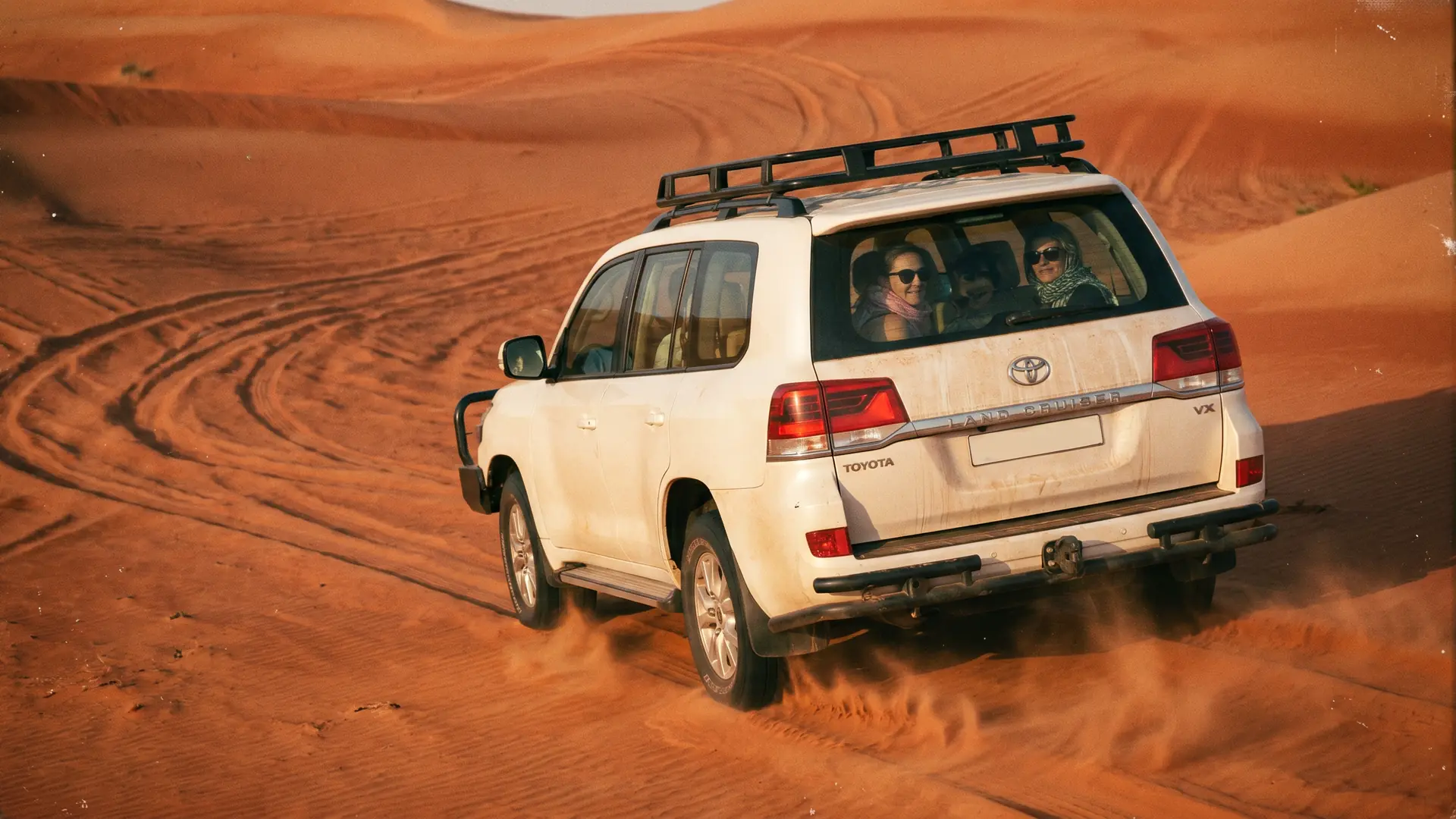
Your own driver, your own table at the camp, and timing set to whatever suits your family's headcount rather than a fixed group schedule.
A few options sit outside the packages listed here — a private morning departure runs AED 799, the private evening version AED 1,400, and overnight camping suits a family keen to wake up out in the dunes. Motion sickness in the back seat, whether it's a child or a grown-up feeling it, is common enough that a calmer route without the dune bashing can simply be requested instead.
You're picked up while it's still dark, roughly 4:30 in the morning, and touch back down before most hotel breakfasts have even wound up. Unlike everything else on this page, nobody splits by machine here — the whole family climbs into one basket together.
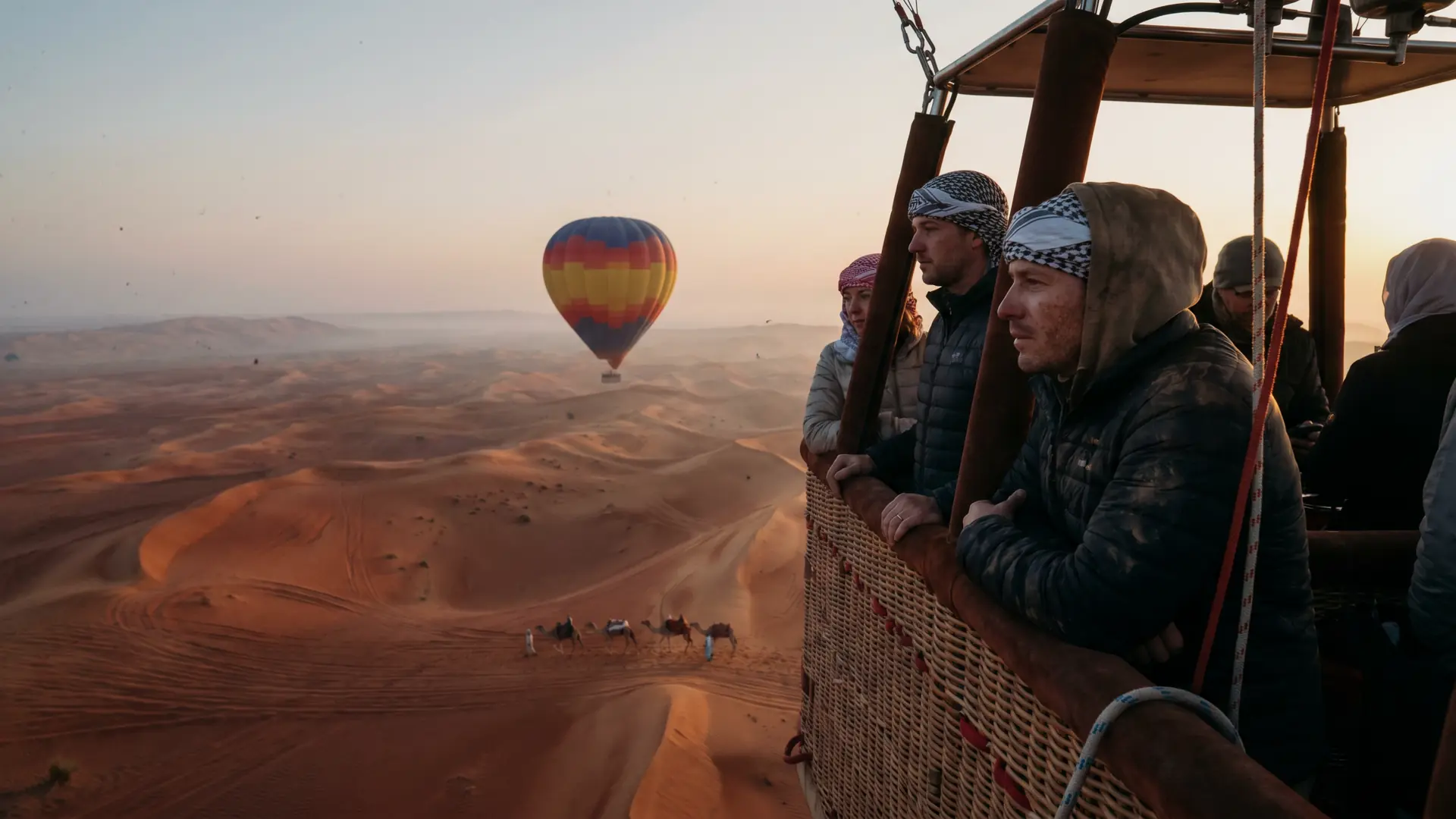
Three price points on offer: AED 1,049 gets the standard flight airborne, stepping up to AED 1,149 folds in falconry, and AED 1,349 covers the version with a full breakfast afterward. Peaceful while it lasts — the volume returns once the ATVs start.
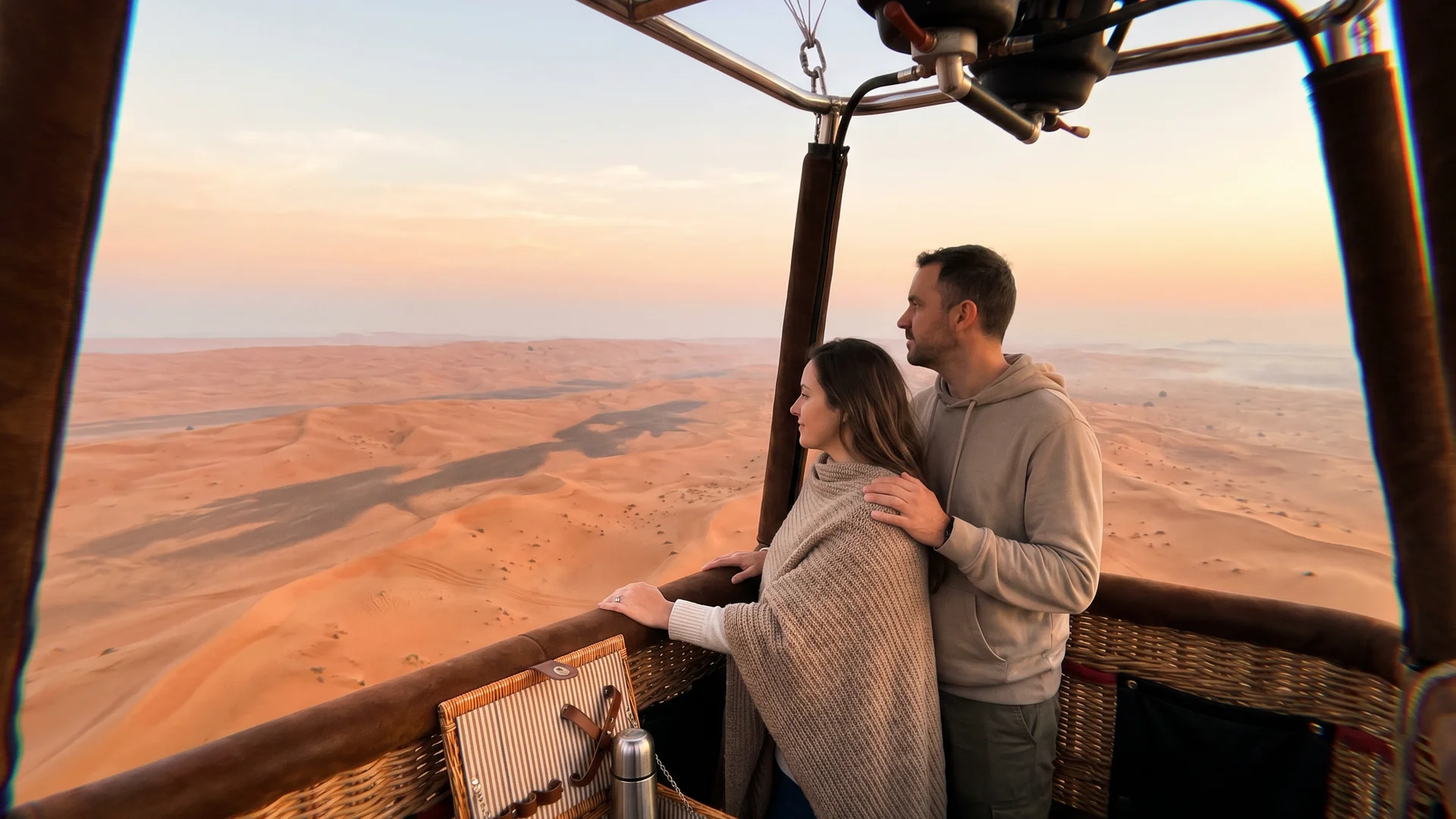
The whole balloon to yourselves. Anniversaries, milestone birthdays, a family morning nobody else is sharing.
The gentlest activity on this page, and the one with almost no age floor — camel rides welcome children from age three with an adult alongside.
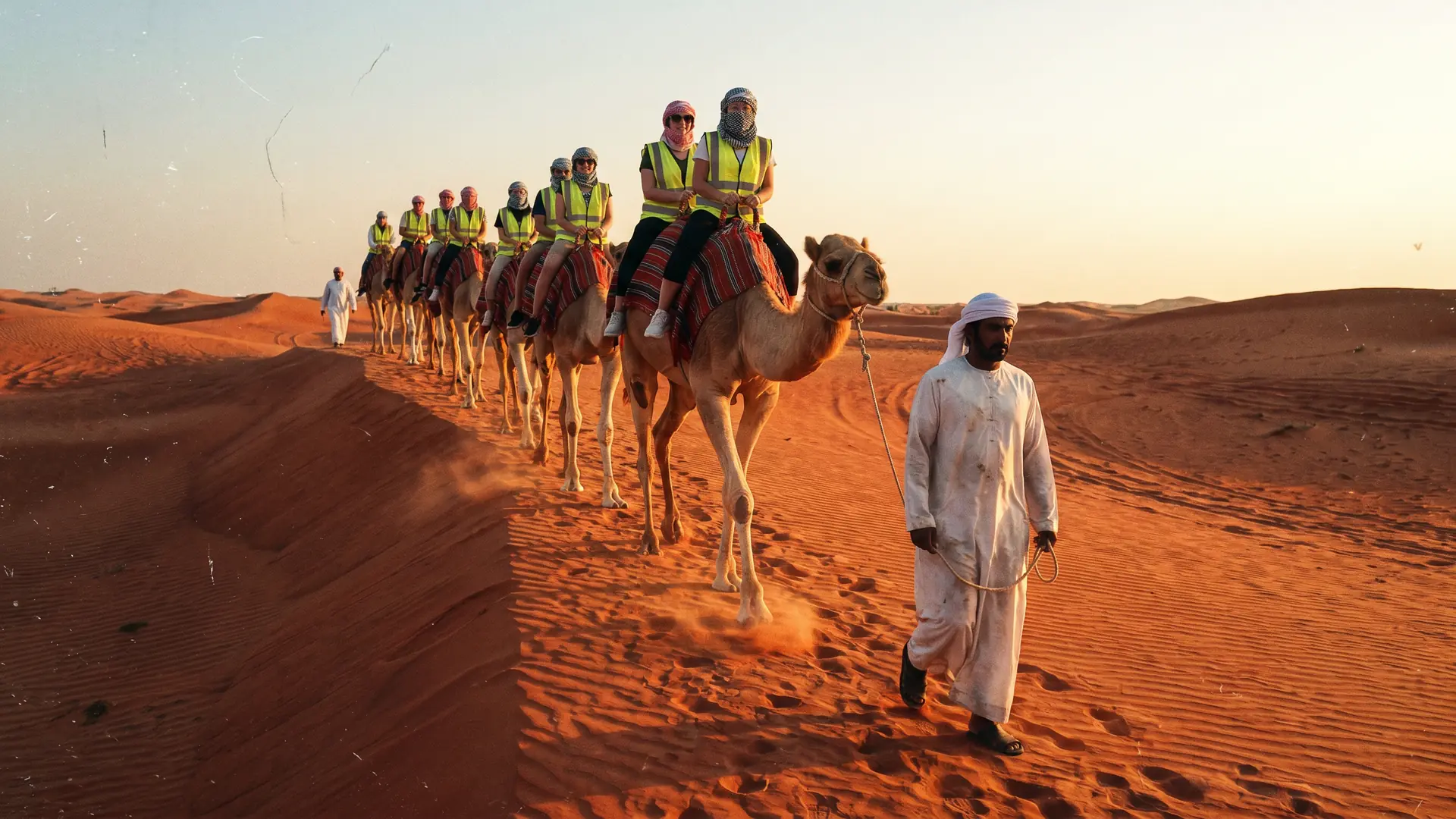
Same stretch of dunes the ATVs cover, just at camel pace with a guide walking the route — a gentle option for the youngest while older siblings take their turn on the 90cc.
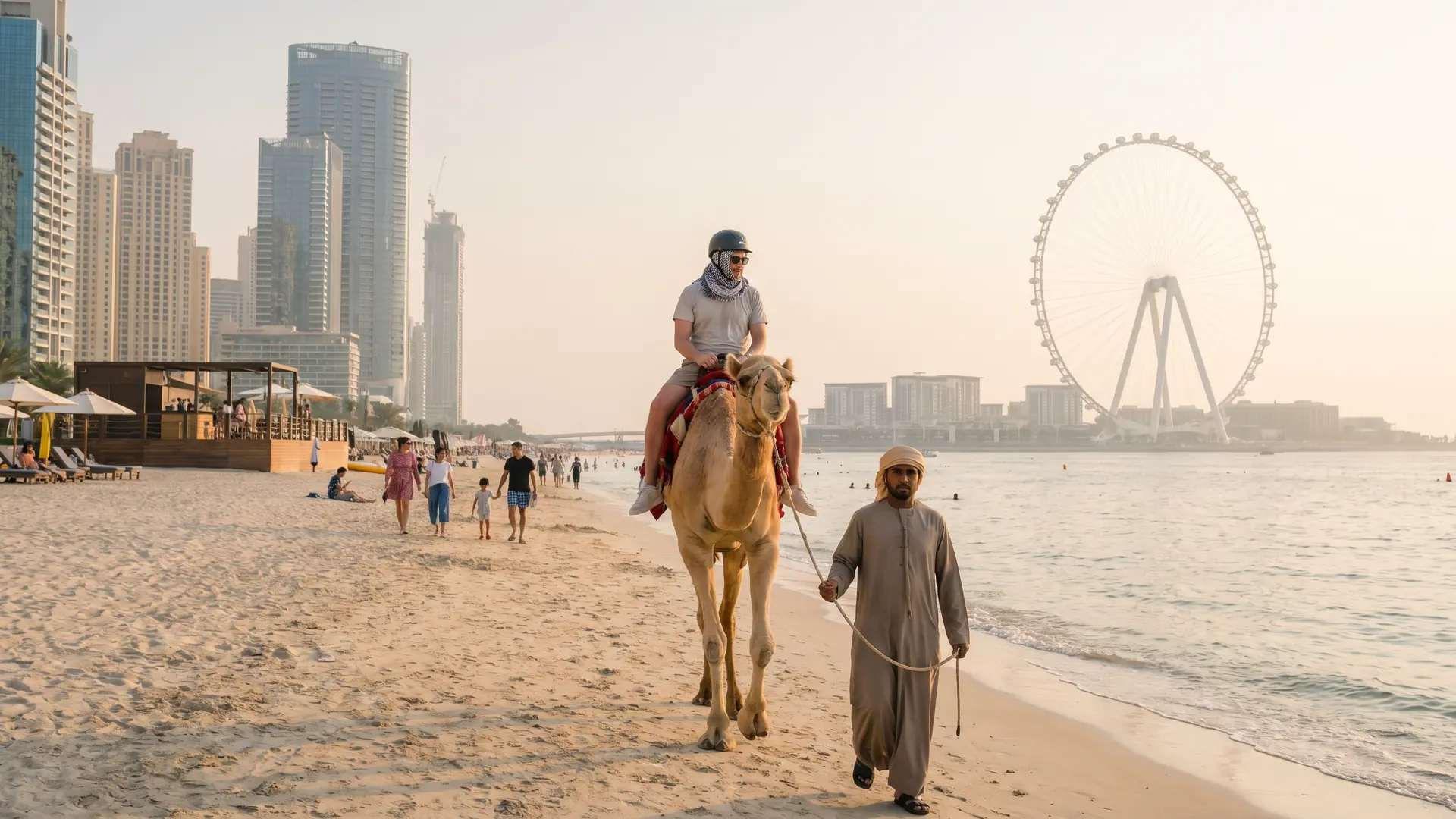
This one skips the drive out to Al Lahbab entirely, since it happens right on the sand at JBR — and it tends to be the photo a family actually ends up sharing.
For an older child or teen who's spent time in a saddle before, guided desert horse riding is also on offer, priced from AED 575.
These don't come off a fixed price sheet. How many are riding, their ages, the machines picked and the length of the day you want all move the final number around, so message the details across and expect a figure back the same day.
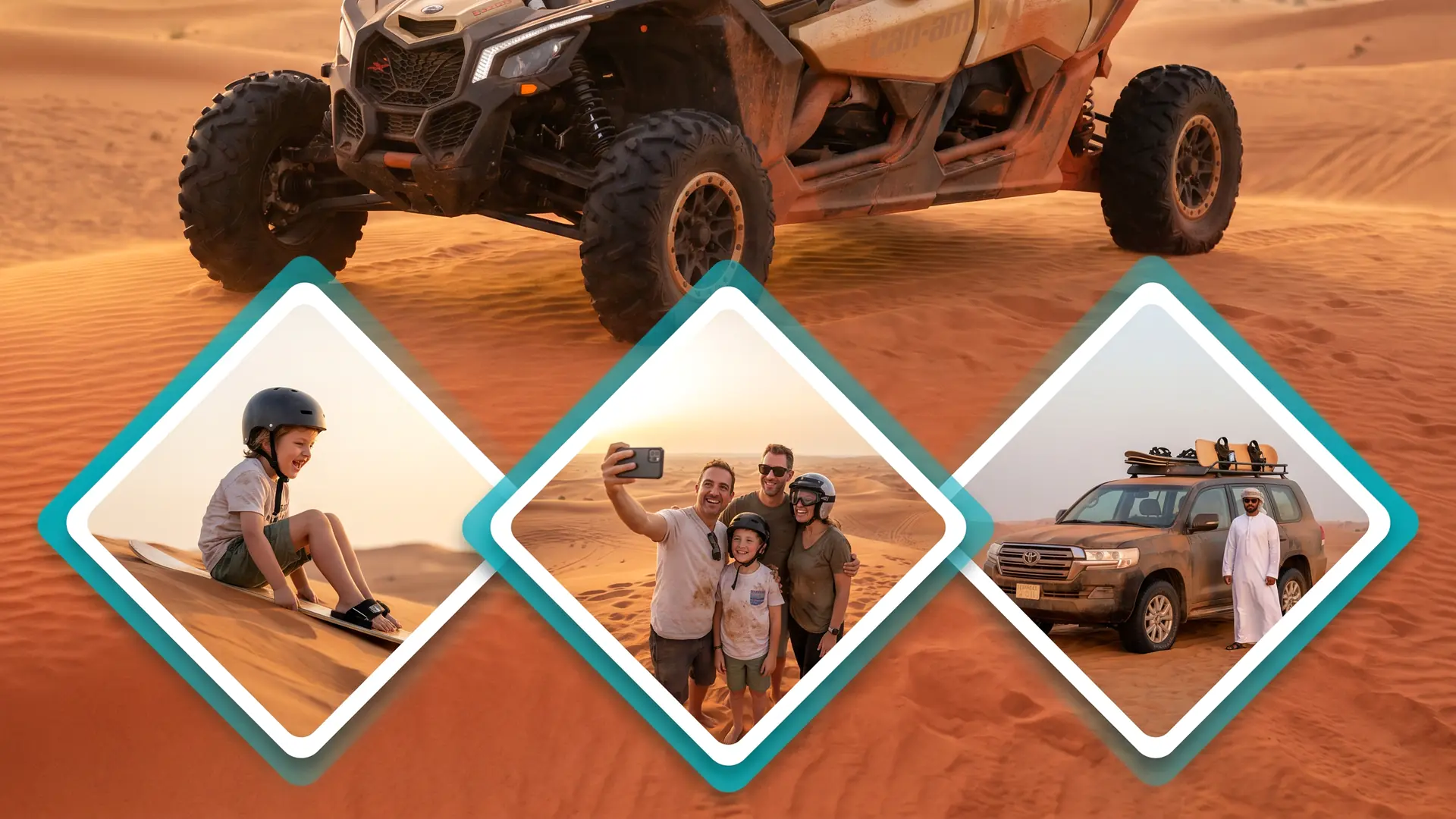
Stack the kids' 90cc, an adult ATV route, a buggy leg, the safari and the BBQ camp into one booking and expect somewhere between AED 700 and AED 2,200 depending on what's picked. The ultimate version tacks a sunrise balloon onto the front, though that early wake-up call suits an older child better than a young one.
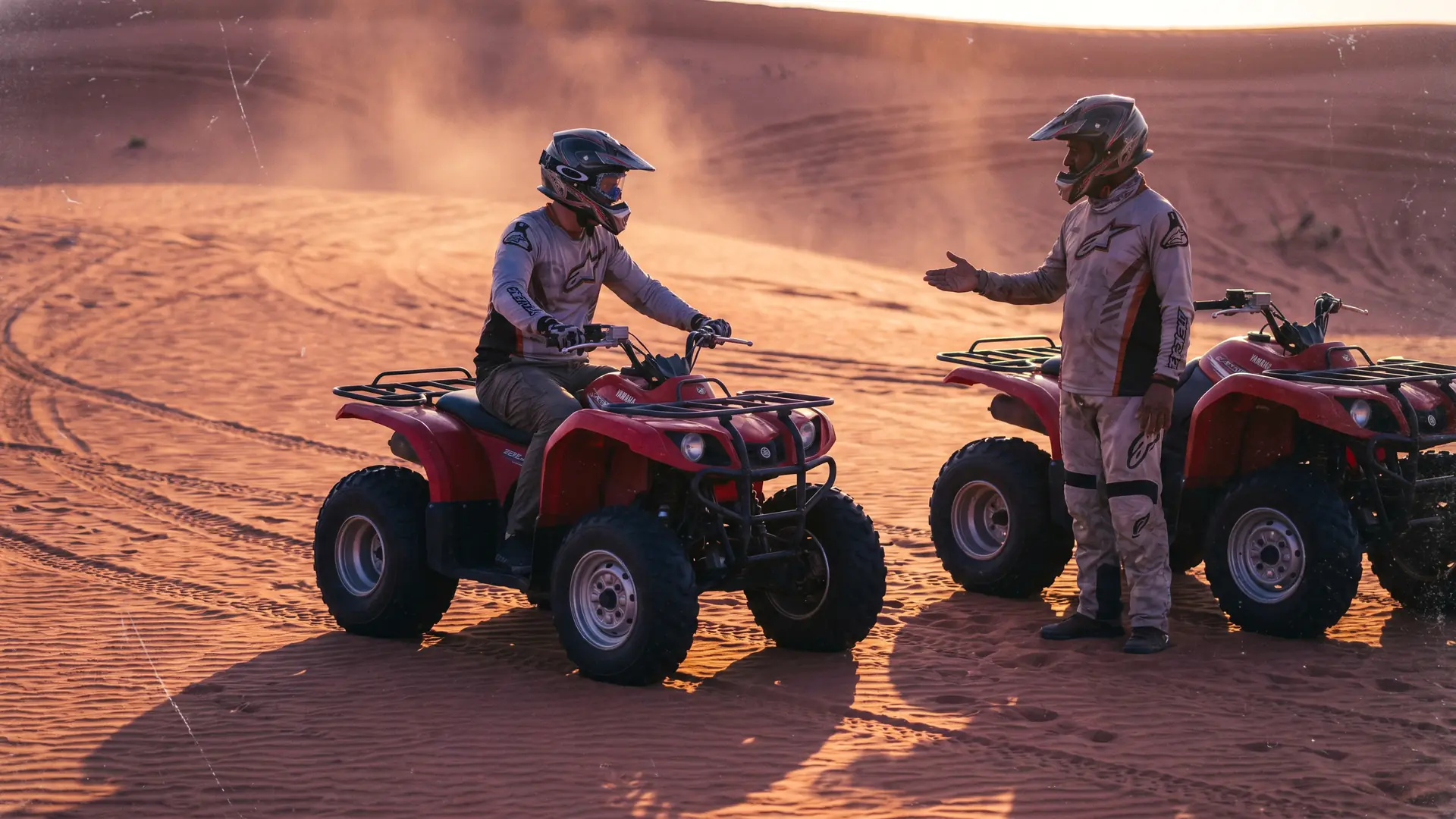
Grandparents in the safari 4x4, parents on the ATV route, kids on the 90cc lane — three generations, one booking, one camp at the end of it.
Southeast of the city, off the road toward Al Ain, is where Al Lahbab sits — the actual base for the whole family fleet, kids' lane and adult routes both. Nothing about the red sand in the photos is exaggerated, and the ground behind it matches: real bowls and ridgelines, not the flattened terrain closer to the highway.
No machine heads for a dune before a warm-up on flat ground back at base first — one guide reads the parents' laps there while a second stays fixed on the kids' lane. That division of attention is essentially the whole safety system, and it's how a route ends up matched to whoever's actually riding it.
The same sequence every time. Only the size of the group and the length of the riding section change.
A hotel collection means the whole family rides out together in one vehicle; anyone driving themselves gets meeting-point directions as soon as the booking is confirmed.
Adults and kids are briefed separately — throttle, braking and hand signals for the grown-up group, then a shorter, simpler walkthrough for whoever's riding the 90cc.
Parents run their warm-up laps on flat sand while a second guide watches the kids' lane, and that read is what decides the adult route.
Adults follow the lead guide nose-to-tail through the bowls and ridgelines while children loop the supervised track in full view of the staging area.
Everyone regroups at base for water and a breather, and the day's photos — the adult route and the kids' laps both — get handed over before anyone heads home.
Booked the BBQ? The whole family walks to the camp together from here, no separate car needed.
Nine to twelve is the bracket the 90cc lane covers, guardian required on site the whole time. A younger child still rides, just differently — tucked into the buggy alongside a driving adult, or up on a camel from age three. If a child in your group sits right on that line, mention it on WhatsApp ahead of the day rather than at the briefing, when there's no real time left to work through it properly. Dream Land Adventure Tourism holds the DTCM licence this operation runs under, and on the sand, the call a guide makes in the moment is the one that stands.
Based on 796 Google reviews
Based on 1,364 reviews
Every rider pays their own fare, children included. A child's seat on the supervised 90cc runs AED 150; grown-ups begin at AED 200 on the 220cc and top out at AED 795 on the Raptor once they've been cleared for it, though the 400cc at AED 250 is where most parents land. Add the safari and the BBQ camp to the mix and a family day comes to AED 290 if it's morning, AED 375 if it's evening.
Yes, same machine — the name just depends on the market. North America tends to say ATV; the UK and this region usually default to quad or quad bike. Either word gets you to the same family-sized fleet on this page.
At Al Lahbab, southeast of the city along the road toward Al Ain — figure on 45 minutes door to door from Downtown. It's also the reason the dunes in the photos look that deep red; sand nearer the highway is a much paler colour by comparison.
No licence is needed, given the riding takes place on private desert land. No prior experience either — flag that at the briefing and the 220cc is what you'll be handed. It's the flat-sand warm-up afterward that lets a guide fit the adult route to the person actually riding it.
Yes, on both lanes. One guide leads the adult route through the dunes; a second stays with the kids' 90cc lane for the entire session. Nobody, child or adult, is sent out alone.
Not automatically — it gets quoted separately and agreed before anything is paid. Collection is routine from Marina, Deira, JBR, Downtown and Business Bay. Families driving themselves are just as common, with directions sent through once the booking is locked in.
Once the drive is factored in, it eats up most of a half day. The riding session itself isn't long, but getting to and from central Dubai adds close to an hour and a half round trip — which is exactly why most families stack a safari or the BBQ camp onto the same visit instead of making the drive for one short ride.
Everyone needs closed-toe shoes, plus sunglasses and an outfit nobody's precious about, since sand gets everywhere — helmets come with the booking. If there's one item worth packing above the rest, it's a buff or scarf for each face. Leaving a change of clothes in the car turns the ride home into something far more bearable, particularly for a child.
It happens on the kids' lane too, usually from easing off the throttle on a soft patch. The guide watching that lane pulls the machine free within a minute or two — no fee, and no fuss made of it.
ATVs make sense once every rider old enough wants their own set of wheels, given the cost is per person riding. A buggy earns its place when there's a child too young even for the 90cc, letting them ride along in a seat next to whoever's driving. Most families spanning a wide age range book a combination of the two rather than picking just one.
Riding doesn't stop for summer — sessions simply move earlier or later across the late-May-to-September stretch, skipping midday entirely since the heat punishes adults and hits kids even harder. From October through April, the clock stops mattering and any hour rides comfortably.
Sandstorms and strong wind get a family moved to a different slot rather than cancelled outright, with alternatives offered in advance at no extra cost. ATVs handle marginal weather better than the balloon flights, which are the first thing grounded.
Midweek, a couple of days' notice is generally fine; aiming for a Friday or Saturday, give it closer to a full week. Family combo packages and the afternoon slots go first. Secure online advance payment confirms your booking, support available 24/7.
No fixed upper age, provided there's no serious back, neck or heart condition and no recent surgery. Plenty of grandparents ride the 220cc alongside their grandchildren; others prefer the safari 4x4 and meet everyone at the camp.
Around nine years old is where a child in Dubai can start riding an ATV solo — the supervised 90cc, its own marked lane, a guardian required on site, priced at AED 150, with the bracket running up to about twelve. A parent or older teen rides separately, a guided route on a Yamaha picked for their own ability from AED 200, and a second guide never leaves the kids' lane while both groups are out. Not old enough yet? Riding along in the buggy beside a driving adult is the workaround, and camels welcome riders from age three.
The single most-booked package for a first family outing is the Evening Safari with ATV and BBQ at AED 375 — dune bashing that doesn't tire out small arms, both lanes riding at once, and dinner at camp to finish the night. Secure online advance payment confirms your booking, support available 24/7.
Dune bashing, both lanes riding, sunset dinner at the camp.
AED 375Ages nine to twelve, guardian on site, own marked track.
AED 150The parent or teen who has never ridden before.
AED 200What most mums and dads end up riding.
AED 250One seat, two riders, for a child not quite solo-ready.
AED 350Rides along next to a driving parent instead of solo.
From AED 599Open from age three, with an adult alongside.
AED 150Fastest on the fleet, kept off the family lane.
AED 795Nine is the starting point for a child riding their own machine — the supervised 90cc, on its own lane, guardian on site. Below that, riding solo isn't offered at any price.
Nine is not a number picked at random. It's roughly where a child has the height, grip strength and reach to work a throttle and brake on a small machine without an adult's hands ready to intervene, and it lines up with how most desert operators around Dubai set their own cutoffs. The 90cc itself is built down to that size — lower seat height, a gentler throttle curve, shorter reach to the bars — rather than being a full-size quad with the power simply turned down. Full pricing for every machine on the fleet, kids' and adults', sits in the rate table above.
The upper end of the kids' bracket sits around twelve, not because a twelve-year-old suddenly becomes an adult but because that's usually where a growing rider starts to outgrow the 90cc's frame and would get more out of a bigger machine anyway. Once a young teenager is tall enough and the guide is comfortable with it, the 220cc — the same machine handed to first-time adults — is usually the next step, rather than a hard rule tied to a birthday.
None of this is enforced by checking a birth certificate at the gate. The guide makes a judgment call at check-in and again at the warm-up, and a child who's small for nine or unusually capable for eight gets assessed rather than waved through or turned away on the number alone. If your child sits right on the edge of the range, raising it on WhatsApp before the day, rather than at the briefing, gives the team time to actually think it through instead of making the call under time pressure with the rest of the group waiting.
This nine-to-twelve framing is deliberately consistent across every family booking on the calendar, not something loosened case by case to fill a quiet afternoon. That matters if you're comparing quotes elsewhere — a booking that promises a six-year-old their own throttle isn't being generous, it's cutting a corner, and it's worth treating as a warning sign about how the rest of that day gets run.
Below the 90cc age, a child doesn't ride an ATV solo at all — but a buggy passenger seat next to a driving adult, or a camel from age three, covers the same ground.
Every ATV in the fleet, from the 90cc up to the Raptor, is built and insured for one rider controlling their own machine. There's no toddler seat bolted on, no bar to hold behind an adult's shoulders, and no version of the booking where a guide lets a four- or six-year-old ride tucked in front of a parent. It's worth knowing before you arrive with a younger child expecting them to at least sit on something with an engine.
The dune buggy is where that younger child actually gets to ride. The buggies on this site carry passengers properly — roll cage, harness, a seat built for someone who isn't driving — so a five- or seven-year-old can be strapped in next to a parent at the wheel and feel every dip and climb without touching a throttle. It's not a consolation prize; plenty of families book a buggy specifically for this reason even when the older kids are old enough for the 90cc.
Camel rides sit at the gentler end of the same idea and open even younger, from age three with an adult alongside. It's slower, there's no engine noise, and for a child who isn't ready for anything with wheels it's often the better afternoon anyway — especially paired with an evening safari where the rest of the family is doing the ATV and buggy legs nearby.
What doesn't exist, and it's worth being direct about, is a workaround that puts a three- or five-year-old on a real ATV because a parent asks nicely or offers to hold on. The guides aren't being difficult when they say no to this — it's one of the few rules on this page that isn't negotiable at any price, because the machine itself isn't designed for two people or a rider who can't reach the controls.
A child in the nine-to-twelve bracket rides the 90cc, full stop. Adults and older teens choose from the other seven machines based on experience, from the 220cc up to the Raptor 700cc.
There's no menu for children the way there is for adults. Every child in the riding-age bracket gets the same machine — the Yamaha 90cc — regardless of whether it's their first time or their fifth. That's a deliberate simplification: rather than grading children the way the guides grade adult experience, the operator settled on one machine sized correctly for the whole age range and built the supervision around it instead. The full eight-machine fleet is laid out above with specs for each.
Adults get the fuller conversation. A parent who's never ridden anything with a throttle goes on the 220cc, the same light, forgiving machine used to introduce nervous first-timers generally. Most parents, once they've got a season of casual riding or even just motorbike or jet-ski time behind them, end up on the 400cc — it's the machine the standard adult route is built around, and it shows up most often in the fleet for a reason. From there it climbs: the 400cc turbo and the Grizzly 450 for a parent who wants more pull or a longer loop, the 625cc sports quad and the Raptor 700cc for a parent with genuine riding hours who wants twenty minutes that are entirely theirs.
The 400cc double is the one machine that crosses the age line deliberately. It's a single seat built for two, and it exists specifically for a family with a child who's keen to ride but not quite at the solo 90cc age — a parent drives, the child rides tandem, and everyone still gets real time on the sand together rather than one of them sitting it out entirely.
Worth flagging plainly: the Raptor 700cc and the KTM dirt bikes are kept away from the family lane altogether, not just discouraged. They're released to adults only after a short conversation about riding history, and they sit at the opposite end of the fleet from anything a child touches on this site.
Yes — the 90cc runs on its own marked lane beside the main staging area, with a dedicated guide watching it the entire time, separate from whichever guide is leading the adult route.
The kids' lane isn't a scaled-down version of the adult route with the difficult bits removed; it's a different piece of ground entirely. It sits on flat, marked terrain right beside where the adults gear up and start their own ride, rather than out among the bowls and ridgelines the guided adult route uses. That's a practical choice as much as a safety one — a parent getting fitted for a helmet can still see the 90cc lane the whole time.
Supervision on that lane is constant, not a guide who checks in every few laps. While the lead guide takes the adult group out into the dunes, a second guide stays at the kids' lane for as long as any child is riding it, watching pace, correcting technique in real time, and calling a stop the moment anything looks off. It's the same principle as the adult warm-up assessment, just applied continuously rather than as a one-off check before the real route starts.
Pace on the 90cc is set low by the machine itself before a guide even needs to step in. It's not a Raptor with a limiter switched on; it's genuinely built with a gentler throttle response and a lower top end, so a child leaning too hard on the accelerator doesn't get the same result an adult would on a bigger machine. That's part of why the margin for error here is built into the hardware, not just the supervision layered on top of it.
None of this changes if the family books a longer adult route or a full-day combo. The kids' lane runs on its own clock, and a child doesn't get pulled off it early just because the parents' route happens to be running long that day — the two sessions are timed to finish together, not to force one group to wait on the other.
Both at once. Parents ride their guided route while the kids loop the 90cc lane in the same window, and everyone regroups together at the end rather than taking turns.
This is one of the more common questions before booking, usually from a parent picturing a single guide leading one long line of mixed-age riders through the dunes, with a child on a 90cc somehow keeping pace with adults on 400s. That's not how it works, and it wouldn't be safe if it did — a 90cc simply can't hold the speed of the adult route, and asking it to would mean either the adults crawling or the child being left behind.
What actually happens is a genuine split that still runs on the same schedule. Parents head out with the lead guide on their own route through the bowls and ridgelines; at the same time, back at base, the kids are looping the supervised 90cc lane with a second guide. Both sessions start close together and are timed to wrap up together, so nobody's sitting around at the end waiting on the other group to finish.
For families where one parent would rather not ride at all, the split works differently but just as cleanly — that parent takes the safari 4x4 alongside the kids' lane, watching the whole session, while the other parent does the guided ATV route. Either way, the family regroups at the same water stop, looks at the same set of photos from both sessions, and moves into whatever's booked next, the BBQ camp or the drive home, as one group again.
The one thing that doesn't happen is a shared route where ability levels get averaged out. Guides here would rather run two sessions at two honest paces than one session at a pace that's wrong for everybody in it, and families who've tried the single-group version elsewhere tend to notice the difference immediately.
Closed shoes, a face buff, sun protection and an honest expectation talk beforehand. The gear list is short; the conversation matters more than the packing.
What a child needs barely differs from what an adult needs. Footwear is where it starts — closed-toe shoes, no exceptions, since sandals and footpegs are a bad combination, and it's typically the very first thing a guide glances at before anyone approaches a machine. Sunglasses make the drive out easier on young eyes, and a buff or light scarf is worth packing specifically for a child, since smaller riders notice sand in their eyes and mouth sooner than grown-ups do. Leaving a full change of clothes in the car turns the ride home into something everyone's actually grateful for.
What's worth more than any item on a packing list is a five-minute conversation before you leave the hotel about what the session actually involves — that it's on their own machine, on a marked lane, with a guide watching, and that it's fine to go slowly or even stop and watch for a lap if it feels like a lot. Children who arrive with an accurate picture of what's coming tend to relax into the warm-up faster than children who were told it would be like a go-kart or oversold in some other way that doesn't match a 90cc on sand.
Sun and heat matter more for a child than most parents plan for, since kids dehydrate faster and are worse at noticing it themselves. Water is provided through the session, but a filled bottle in the car for the drive there and back, plus sunscreen applied before arrival rather than after, covers the gap. Booking a morning or evening slot rather than the middle of the day makes a bigger difference for a child than for most adults.
Bring the same honesty about experience that the guides ask for at the briefing — if this is genuinely a first time on anything with an engine, say so. It doesn't change the machine a child gets, since the 90cc is the only option in that age bracket regardless, but it does change how the guide talks a child through the first few laps, and that first five minutes tends to set the tone for the rest of the session.
Built around the kids specifically — the 90cc, the lane and the pace all exist because children were the harder problem to solve, not an afterthought bolted onto the adult product.
It's a fair question, because plenty of desert activities marketed as family-friendly turn out to mean a child sits somewhere safe while the adults do the actual activity. That's genuinely true of some of the other bookings on this page — the KTM dirt bikes, the sports quad — which are built for a parent's solo moment and don't pretend otherwise. The 90cc lane is the opposite case: it exists because children specifically wanted to drive something, not watch someone else drive it.
What makes it land with kids, based on what shows up in reviews and repeat bookings, is the same thing that makes the adult route work — actual control, not a simulation of it. A child on the 90cc is steering, braking, managing their own line around the lane, not being pulled along on a rope or riding behind an instructor. That sense of doing it themselves, on a machine sized so it doesn't fight them, is usually what gets mentioned first when a family comes back for a second trip.
The supervised lane also removes the part of riding that makes it stressful rather than fun for a child — open, unmarked terrain with no clear edges. Adults get the bowls and ridgelines precisely because that unpredictability is the appeal for someone with the skill to read it; a child on their first machine generally doesn't want that yet, and the marked lane gives them repeatable laps to get better at instead, which is a different kind of satisfying.
The honest caveat: not every child loves it, and that's fine. Some nine-year-olds are thrilled from the first lap; others want to watch for five minutes before trying, and a few decide after one loop that the camel ride or the buggy passenger seat suits them better. The lane's whole design — low pressure, a guide right there, no fixed lap count — is built to let a child make that call themselves rather than being talked into finishing a session they've stopped enjoying.
Same flat rate across the nine-to-twelve bracket — AED 150 regardless of whether a child is nine or twelve. There's no sliding scale by age within that range.
No — every 90cc is single-rider, the same as the rest of the fleet. The 400cc double is the shared-seat option, but that's built for a parent riding with a child, not two children together.
That's the default case, not an exception. The 90cc briefing assumes zero experience for every child in the bracket, so a first-timer at ten gets exactly the same walkthrough as one who's ridden before.
The whole session. The two guides — one leading the adult route, one on the kids' lane — run in parallel and finish together, so a child isn't limited to a few laps while waiting for parents to return.
The younger sibling still under the cutoff rides tucked into the buggy with a parent at the wheel rather than taking the 90cc solo, while the older one old enough for the bracket gets their own machine entirely. Both stay out on the sand at the same time, just not on matching vehicles.
Provided, sized for the rider. Helmets aren't something families need to bring, for children or adults — fitting happens as part of the briefing before anyone gets on a machine.
Yes. The kids' lane isn't a timed course with a fixed number of laps — a child can pull over, take a break, or stop early, and the guide watching that lane manages it without affecting the adults' separate route at all.
Yes — a child's 90cc session and an adult's ATV route are both part of that AED 375 package, alongside the dune bashing and the camp dinner. It's the most-booked way for a family to try both in one evening.
The guide makes that call at the warm-up, not from a height chart. A returning child who's visibly outgrown the 90cc gets moved toward the 220cc conversation the same way any young teenager would, on the day rather than by a fixed rule.
Regularly. The adult route doesn't require a parent specifically — any adult clear of the medical exclusions can ride the guided route or sit with the kids' lane, which is how several three-generation bookings end up splitting the day.
Choose the machines for everyone riding, lock them in with online payment, and WhatsApp settles the family's exact pickup time the evening beforehand.